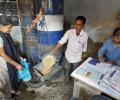
"The world might face a food crisis if the war continued till the end of April, as it could have a dramatic impact on planting in Europe and North America," said Matt Simpson, CEO of Brazil Potash.

Gautam Adani emphasised the importance of energy security and digital infrastructure in shaping geopolitical power, urging India to develop sovereign capabilities across the AI value chain.

Prime Minister Narendra Modi addressed the BJP's 47th Foundation Day, highlighting the Uniform Civil Code and 'One Nation, One Election' as key unfinished agendas. He also reaffirmed the party's commitment to implementing women's reservation in the 2029 elections and criticised dynastic politics.

External Affairs Minister S Jaishankar stated that India has demonstrated resilience in the face of recent global shocks, including the conflict in West Asia, while speaking at the convocation ceremony of IIM Raipur. He emphasised the importance of building national capabilities to de-risk and develop leverage in a changing global order.

Global brokerage Bernstein has issued a cautionary note, stating that India risks 'under-delivering on its potential' unless it addresses key policy bottlenecks and structural risks, including employment challenges from AI, limited manufacturing gains, and rising welfare spending.

ICC CEO Sanjog Gupta discusses the globalisation of cricket, highlighting India's crucial role and the impressive performances of Associate nations in the T20 World Cup.

Developing countries' return to high growth will require them to resume the push into tradable goods and services.

The World Anti-Doping Agency (WADA) is shifting its focus from individual athletes to the criminal networks that supply performance-enhancing drugs (PEDs), recognising that athletes are often victims of sophisticated doping operations.

The US torpedo attack on the Iranian warship IRIS Dena in international waters was a lawful act of war between belligerents, not a diplomatic or strategic embarrassment for India, asserts Vice Admiral Biswajit Dasgupta (retd).

'There is a lot of euphoria in the country after a trade agreement is signed. But it is an illusion for us. What is more important is making it real.'

Nepal's captain Rohit Paudel has emphasized the need for increased international cricket engagements for his team following their narrow defeat against England in the T20 World Cup. He believes regular exposure to top teams is crucial for the development of Nepali cricket.
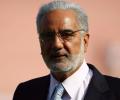
Inderjit Bindra, who raised Indian cricket on the world stage in the 1990s and early years of this century, passed into the ages on Sunday. 26 years ago, Mr Bindra spoke at length to Rediff about his vision for Indian cricket, an interview which we republish in his memory.

IMF Managing Director Kristalina Georgieva discusses the potential of artificial intelligence to boost global growth, particularly in India, while also addressing the significant risks of job displacement and financial instability.
In the wake of the FTA between India and the European Union, the United States has described the Europeans as 'very disappointing', saying they were unwilling to join Washington, DC in putting tariffs on New Delhi for its purchases of Russian oil because of this trade deal.

Canadian Prime Minister Mark Carney on Tuesday warned that the world is witnessing a fundamental 'rupture' in the global order rather than a gradual transition, cautioning against weaponising trade, finance, and supply chains.

Bhagwat said India's concept of 'rashtra' is ancient, organic and fundamentally different from the Western idea of a nation.
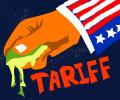
India must focus on building enduring national capabilities and economic sovereignty in the face of shrinking space for rules-based trading, anti-immigrant stance, weaponization of energy sources and growing use of export controls in critical sectors, the Economic Survey said on Thursday.

The recipe for Indian higher education institutions to succeed in the global markets is excellence in academics, promoting contemporary socially relevant material, and enabling individuals (learners) to realise their full potential, suggests N Ravichandran.

Dhurandhar does not ask audiences to cheer blindly, notes Kumar Abhishek. It asks them to see how power operates in grey zones, and at moral cost.

India should plan its strategies on the assumption that the rightward swing will stay and the West will retreat into an economic fortress, says Nitin Desai.
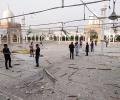
Chinese Foreign Minister Wang Yi stated that China mediated tensions between India and Pakistan, a claim disputed by India which maintains that the matter was resolved bilaterally.
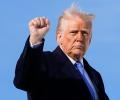
'Many of these issues will be resolved within 6 months because the US economy has started unravelling.'
Incidents such as the violent clashes in Assam only tell us that we need to sensitise the youth about our country -- especially the borders states -- of which they have very vague notions, says educator Chitra Jeyakumar

Amid US-China trade tensions and economic vulnerabilities, India must seize the 'China +1' opportunity, deepen reforms, secure FTAs, and globalise its firms for long-term growth, suggests Ajay Shah.

'You are a guest in the US. It's not your home, you're a guest. If they don't feel comfortable, you have to step out.'
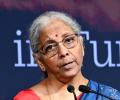
Finance Minister Nirmala Sitharaman on Friday said the world is facing "profound imbalances" in trade and energy security, and is undergoing a structural transformation, with India standing out as a 'stabilising force' that can withstand external shocks.

Two modules published by the NCERT, Swadeshi: Vocal for Local (for middle stage) and Swadeshi: For a Self-Reliant India (for secondary stage), carry excerpts from the prime minister's Independence Day address in which he stressed that self-reliance would drive India's journey towards a Viksit Bharat.

'He knew the world's eyes were on him, and he had to speak directly to the fears that immigrants in New York feel right now.'

There has never been a moment in India's history when it has been so adrift in the world, so confused about what it stands for and against and so humiliated, asserts Aakar Patel.

Speaking at the 'Samudra se Samruddhi' event, where he inaugurated and laid foundation stones of projects worth Rs 34,200 crore, Modi said all the problems of India have only one solution, and that is self-reliance.
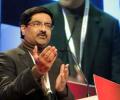
'While the march of globalisation is perhaps inevitable, what is certain is that the world is no longer flat as, the emerging pattern of trade is more regional. 'This new trend of 'slowbalisation' raises some questions that challenge conventional wisdom on how businesses should distribute their capacities,' Birla said.

In the short run, the Trump presidency has already ensured one thing: The assumptions of the past can no longer guide the strategies of the future, points out Manish Dabhade.

'And then the people who call themselves great nationalists, I can bet you that 99 per cent of them are dodging taxes, have sent their kids to America, or are doing everything to make sure that what goes on in this country doesn't affect their personal wealth or their whatever bull*&$%.'
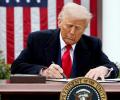
No experts, clearly, were involved in the design of these new tariffs, which have been the subject of bemused wonderment across the world in how completely they ignore logic, rationality, fairness, and economic theory, observes Mihir S Sharma.

When the government chooses to either ignore or use identity documents only when it suits them, it shakes people's sense of stability, notes Shyam G Menon.

The United States offers an "abundance" of stability and transparency, which makes the world's largest economy an attractive investment destination for the Aditya Birla Group, a top official from the Indian conglomerate has said. Kumar Mangalam Birla said the group chaired by him has invested $15 billion in the US over the last 17 years, making it the biggest Indian investor in the country.
When the government chooses to either ignore or use identity documents only when it suits them, it shakes people's sense of stability, notes Shyam G Menon.
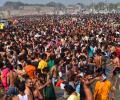
In 1911, French pilot Henri Pequet flew the world's first official airmail, carrying over 6,500 letters and postcards, during the Kumbh Mela in Allahabad, now Prayagraj. The flight, which covered five miles in 13 minutes, marked a significant milestone in aviation and postal history. The mail included letters to Jawaharlal Nehru and King George V, and special commemorative postcards signed by Pequet are now prized collector's items. The event, which coincided with the Kumbh Mela, highlights the intersection of spiritual and technological advancements in India's history.

The iconic editor who reshaped fashion, has transcended her role as editor and become a pop culture icon, famously immortalised in the movie, The Devil Wears Prada.

Any industrial policy is only as good as how it is applied and the other reforms that support it. This was as true 40 years ago as it is now, points out Debashis Basu.
 © 2026 Rediff.com - Advertise with us - Disclaimer - Privacy Policy - Sitemap - Feedback - About us - Terms of use - Grievances